Generating TOTPs for CyberArk (now Idira) Privileged Session Manager Webapp Connectors using a PreConnect DLL

With version 13.0 of CyberArk (now Idira)'s Privileged Session Manager, as part of a Webapp PSM connector, you can inject a time-based one-time password. You can even store the secret for the TOTP in a separate account and link it as a logon account to secure it.
As the latest LTS version is 12.6, many customers are 'stuck' without TOTP injection support but by using a custom PreConnect DLL for Webapp PSM connectors -- a feature introduced in PSM version 12.2-- we can achieve the same functionality and have TOTP injection with PSMs as early as version 12.2
What is a PreConnect DLL?
A PreConnect DLL is a piece of code that is run before a Webapp PSM connector's WebFormFields is executed. Account properties can be passed to the DLL as parameters and return values can be used in the connector's WebFormFields' input fields. CyberArk provides straightforward documentation on how to develop and configure a PreConnect DLL.
Creating the PreConnect DLL
We will keep the PreConnect DLL simple.
It will take a single parameter -- logonaccount_password -- being the TOTP secret, generate a six-digit TOTP using it, and return the TOTP. We will use &MfaCode& to represent the TOTP for use in the WebFormFields.
As version 12.2 of the PSM comes with Otp.NET out of the box in the Components folder, we will re-use the library to do the OTP generating and leave our PreConnect DLL to handle just the receiving of the parameter and the returning of the TOTP. With this, we have only a single file we need to distribute to each PSM.
using CyberArk.PSM.WebAppDispatcher.PreconnectUtils;
using OtpNet;
using System;
using System.Collections.Generic;
using System.Net;
using System.Security;
using System.Text;

namespace CyberArk.PSM.GenerateTOTPPreconnect
{

    public class GenerateTOTP : IPreconnectContract
    {
        private readonly string TOTP_OUTPUT_PARAMETER = "MFACode";

        public Dictionary<string, SecureString> GetParameters(Dictionary<string, SecureString> parameters, LogUtils.WriteToLogHandler writeToLogMethod)
        {
            string totpCode;

            try
            {
                byte[] totpSecretBytes = Encoding.UTF8.GetBytes(new NetworkCredential(string.Empty, parameters["logonaccount_password"]).Password);

                writeToLogMethod("Generating TOTP.", Consts.LOG_LEVEL_INFO);

                var totp = new Totp(totpSecretBytes);
                totpCode = totp.ComputeTotp();
            }
            catch (KeyNotFoundException ex)
            {
                writeToLogMethod(string.Format("Key not found in parameters dictionary: {0}", ex.ToString()), Consts.LOG_LEVEL_ERROR);
                throw new PreconnectException("Key not found in parameters dictionary");
            }
            catch (Exception ex)
            {
                writeToLogMethod(string.Format("Error while generating TOTP: {0}", ex.ToString()), Consts.LOG_LEVEL_ERROR);
                throw new PreconnectException("Error while generating TOTP");
            }

            writeToLogMethod("Successfully generated TOTP.", Consts.LOG_LEVEL_INFO);

            return new Dictionary<string, SecureString> {
                {
                    TOTP_OUTPUT_PARAMETER,
                    new NetworkCredential(string.Empty, totpCode).SecurePassword
                }
            };
        }
    }
}
After compiling the DLL and moving it to the Components folder of our PSM, we are ready to leverage it with the Webapp PSM connector.
You can find the code and Visual Studio project, including a compiled DLL, in my GitHub repository below:
https://github.com/aaearon/CyberArk.PSM.GenerateTOTPPreconnect
Configuring the Webapp PSM Connector
With the compiled DLL copied to all PSMs,
Ensure that the Webapp PSM connector has
LogonAccountadded under Component Parameters > Target Settings > Supported Capabilities.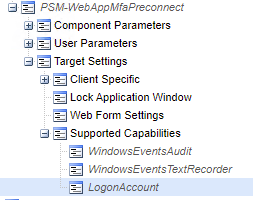
Add the required parameters
PreConnectDllNameandPreConnectParametersas described in step three. ForPreConnectDllName, specify the name of the DLL (CyberArk.PSM.GenerateTOTPPreconnect.dllif downloaded from my GitHub repository) and forPreConnectParametersprovide justlogonaccount_password.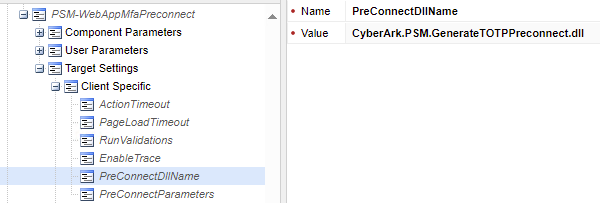
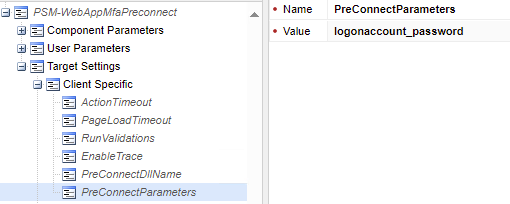
In
WebFormFields, use&MfaCode&to inject the TOTP in the desired input field.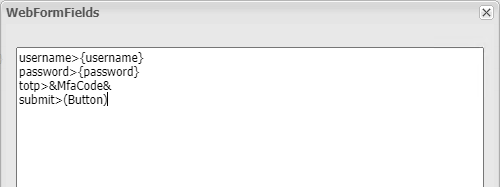
Connecting with our Webapp PSM connector, the TOTP is generated based on a secret that is stored as the password for the account's linked logon account.
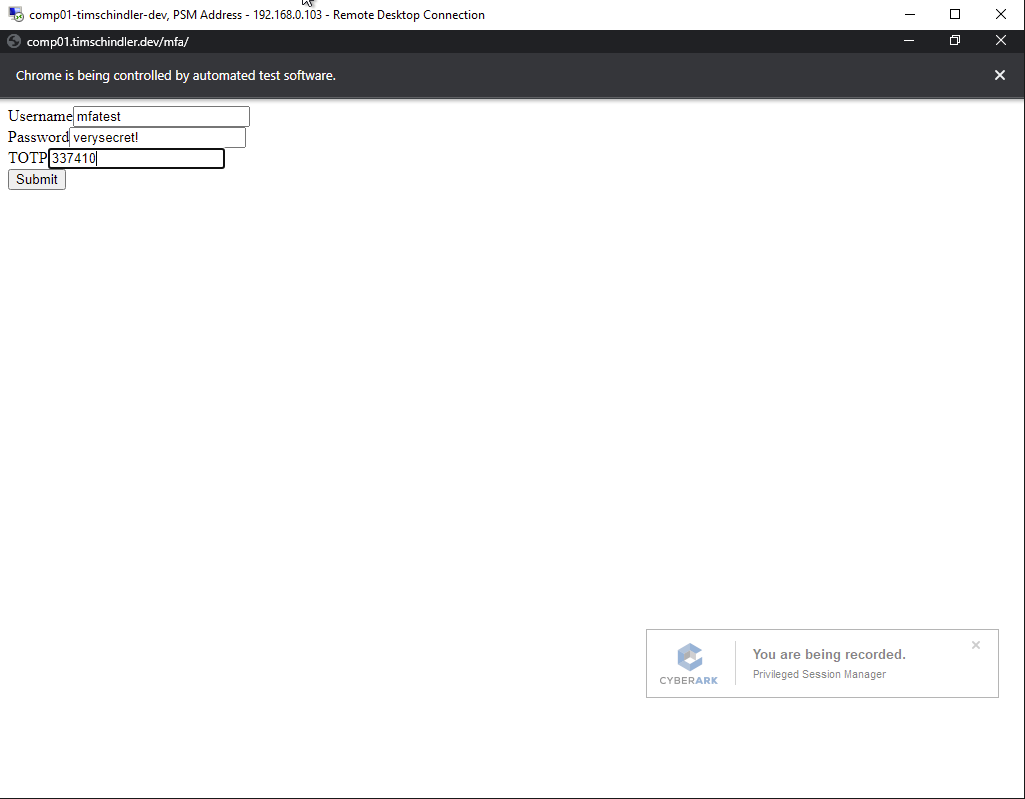
The code and a compiled DLL can be found at https://github.com/aaearon/CyberArk.PSM.GenerateTOTPPreconnect.
About the author
- Originally from the USA, working in Amsterdam, Netherlands in the digital identity space.
Comments
Join the discussionHi, I have follow the steps from the article, however it doesn´t work, page responds saying that the code is invalid. Could it be because in the webformfields you use MfaCode instead of MFACode as in the code?
What is the generated TOTP ? Is it actually an OTP? You can see this by injecting the OTP into a field that isn’t obscured, like the username field.
Failing that, can you generate a valid TOTP manually with the secret stored as the logon account’s password (when you show/copy the secret out of CyberArk?) When you generate it manually, is it the same as what the Preconnect DLL generates ?
If you have the ability to do so, you can clone the example code from GitHub, add debug logging, and recompile.